
You’ve spent hours driving to that perfect campsite. The tent is up, the campfire is crackling, and you’re ready to relax—until you glance at your phone. Fifteen percent. Your camera battery died hours ago. And tomorrow, you still need your phone for GPS on that 10-mile hike.
Sound familiar?
For modern campers, staying connected isn’t just about social media—it’s about navigation, emergency communication, capturing memories, and sometimes even working remotely. But most campsites don’t come with power outlets. So how do you keep everything running for a full week in the woods?
Here are five practical solutions to keep your devices charged during a long camping trip.
1. Bring Extra Power Banks
The simplest solution? Pack more power banks.
Power banks are lightweight, affordable, and easy to find. A decent 20,000mAh power bank can charge a smartphone 3-4 times. For a weekend trip with minimal device usage, that might be enough.
Pros:
- Lightweight and portable
- Inexpensive
- No setup required
Cons:
- Limited capacity
- Can’t charge larger devices like laptops
- Once depleted, they’re useless until you find an outlet
Best for:Short camping trips (1-2 nights) with light device usage.
Tip:Bring two smaller power banks instead of one large one. If one fails, you have a backup.
2. Use Your Car as a Charging Station
If you’re driving to your campsite, your vehicle is a mobile power source.
Most modern cars have USB ports, and even older models can charge devices through a cigarette lighter adapter. While you’re driving to trailheads, resupplying, or exploring nearby towns, plug in your devices.
Pros:
- No extra equipment needed
- Charges while you’re on the move
Cons:
- Only works when the car is running (unless you want a dead battery)
- Not helpful at camp if you’re staying put
- Limited ports
Best for:Campers who drive daily or take day trips from their base camp.
Tip:Get a multi-port cigarette lighter adapter so you can charge multiple devices at once.
3. Harness the Sun with Solar Chargers
Solar chargers have come a long way. Today’s portable solar panels are lightweight, foldable, and surprisingly efficient.
Set up a solar panel at your campsite during the day, and it’ll quietly charge your power banks or devices while you hike, fish, or read a book. By evening, you’ll have fresh batteries ready to go.
Pros:
- Renewable energy—free power as long as the sun shines
- Silent and eco-friendly
- Can work indefinitely on long trips
Cons:
- Useless on cloudy days or in heavy shade
- Slower charging speeds
- Requires positioning and monitoring
Best for:Sunny locations, stationary camps, and patient campers.
Tip:Pair a solar panel with a power bank. Charge the power bank during the day, then use it to charge devices at night.
4. Invest in a Portable Power Station
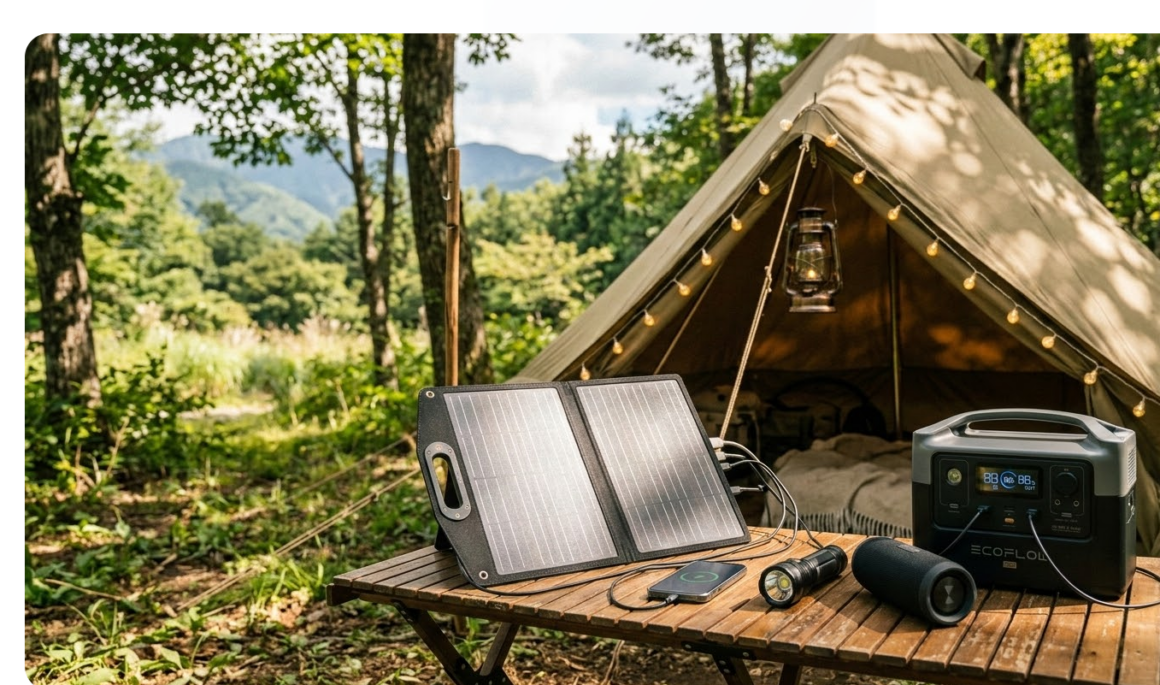
For serious campers who need reliable power for multiple devices over several days, a portable power station is the answer.
Think of it as a giant power bank on steroids. These units pack large-capacity batteries (often 200Wh to 1,000Wh or more) and feature multiple output options: AC outlets for laptops, USB-C for fast charging, USB-A for phones, and even DC ports for car accessories.
What makes them different?
- Capacity:A good power station can charge a smartphone 15-20 times or a laptop 4-5 times
- Versatility:Charge cameras, drones, tablets, and even small appliances like portable coolers or CPAP machines
- Recharging options:Most can be recharged from wall outlets, car chargers, AND solar panels—giving you flexibility
Pros:
- Massive capacity
- Multiple device types supported
- Rechargeable in multiple ways
- Often includes a clear display showing remaining power
Cons:
- Heavier than power banks (though many are still portable)
- Higher upfront cost
- Overkill for short trips
Best for:Week-long camping trips, family camping, RV camping, and anyone who needs to charge laptops or camera gear.
One model worth considering is the Piforz portable power station. It strikes a nice balance between capacity and portability—enough to keep your phone, camera, and laptop running for days, but not so heavy that you dread carrying it from the car to the campsite. On recent trips, it handled charging everything without breaking a sweat, and the clear battery display takes the guesswork out of power management.
If you’re planning multiple long camping trips a year, a power station is one of those purchases you’ll wonder how you lived without.
5. Combine Methods for Maximum Reliability
Here’s the truth: no single method is perfect. The smartest campers combine approaches based on their situation.
Scenario A: Weekend car camper
- Bring one large power bank for evenings
- Use car charging during day trips
- Total cost: Low, minimal planning needed
Scenario B: Week-long base camp with sunny weather
- Set up a solar panel during the day to charge a power station
- Use the power station at night for all devices
- Bring a small power bank as backup for short hikes
Scenario C: Multi-location road trip
- Keep a power station in the car, charging while driving
- Top off devices at each stop
- Use power banks for short excursions away from the vehicle
Scenario D: Cloudy week or heavy shade camping
- Bring a fully charged power station
- Plan one resupply trip mid-week to charge everything in town
- Minimize device usage
By layering solutions, you create redundancy. If one method fails (clouds roll in, your car needs to stay put), you’ve got backups.
Which Solution Is Right for You?
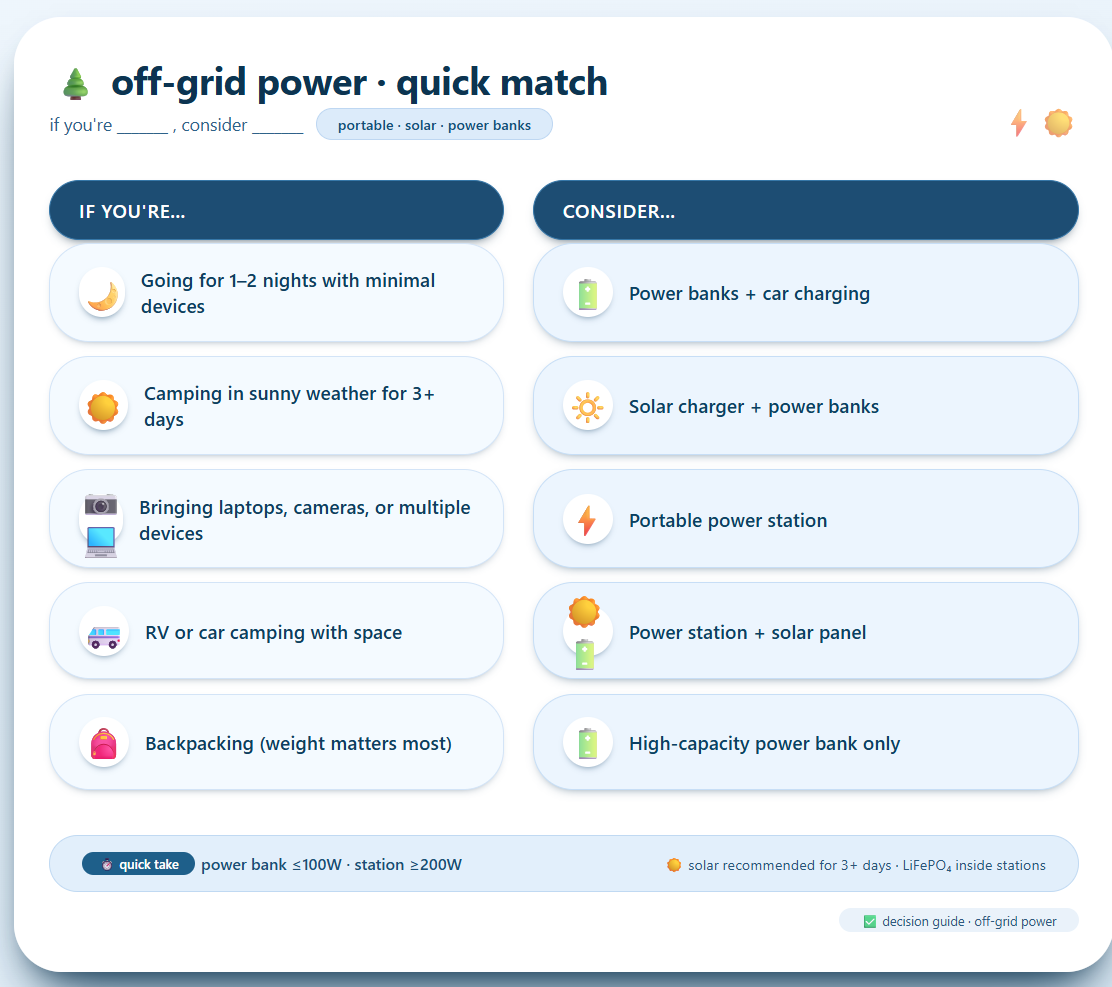
Not every camper needs a power station. Not every trip demands solar panels. Here’s a quick guide:
Final Tips Before You Head Out
- Charge everything fully before you leave home.Start your trip with 100% across all devices and power banks.
- Test your gear.Make sure your solar panel works with your power bank. Confirm your car charger fits.
- Bring cables.All of them. You’ll forget one, and it’ll be the one you need.
- Consider a power strip.If you’re using a power station with one AC outlet, a small power strip lets you charge multiple devices from it.
- Check your campsite.Some campgrounds now offer electrical hookups. If available, it’s the easiest solution of all.
A week in the woods shouldn’t mean a week without power. With the right combination of charging methods—whether that’s simple power banks, solar panels, a portable power station, or all three—you can keep your devices running and focus on what matters: enjoying the trip.
Happy camping—and stay charged.